WHY EARLY CHILDHOOD DEVELOPMENT MATTERS

The first six years shape everything that follows — for a child, and for society.

People walking through a bright hallway with wooden floor and neutral decor.
Team having a discussion around a meeting table in an office.
Project phase
Discovery audit
Cursor icon showing a hand pointer
Planning brief
Execution track
Performance review
It’s all in the details
Why does this matter more than anything else?

90% of brain development happens before age six — and the returns are irreversible.

Before a child learns to read, they learn whether the world is safe.Before school begins, confidence, curiosity, emotional stability, and self-worth are already forming.

These foundations are built — or missed — in the earliest years of life.What is not formed then can rarely be repaired later.
When early childhood lacks care, structure, and guidance, the loss is permanent — not only for the child, but for families, communities, and entire societies.

Early childhood is not the first step of education.It is the foundation of human development.
“But to understand the urgency, we must look at numbers…and at the lived reality of early childhood today.”
THE LIVED REALITY

What early childhood looks like today

Picture a typical morning for a young child in much of the world.

A parent leaves early for work. overwhelmed, alone, and without guidance
The caregiver is loving — but untrained.

She does not know how to support concentration, order, or emotional regulation.

At the local early learning center, one adult manages thirty children, unsupported, with minimal guidance and no materials.
Chaos replaces learning.Stress replaces discovery.

No one intends harm.
But potential quietly evaporates — day after day, child after child.

This is not an exception.
It is the global norm.
“This isn’t just a developmental issue. It becomes a life trajectory — one that is almost impossible to change later.”
Why does this matter more than anything else?

750 million children at risk

750 million children are largely at risk because their parents, professionals and governments are unaware and ill equipped. Without a radical shift societies will continue paying the price in lost productivity, crime, health, relationships and global degeneration
children under 6 will remain off track
250 Million
caregivers are untrained.
150 Million
new Pre Primary teachers are missing
9 Million
Pre primary teachers in low income countries are trained.
<50%
“Inequality does not begin in school.It begins before birth, in the first environment the child enters —the home, the neighborhood, the emotional climate.From that moment, trajectories diverge.Without intervention, the gap widens every year —in vocabulary, in executive function, in emotional regulation,in opportunity, in hope.No country can solve poverty, mental health, violence, or educational failurewithout solving early childhood development.”
Lost Potential almost impossible to regain.

When early childhood goes wrong, you cannot redo it

When the early years are neglected, the consequences echo

What begins as a quiet absence — no conversation, no rhythm, no beauty, no emotional safety — becomes a lifelong reduction in confidence, emotional regulation, and cognitive potential.

And the cost is not borne by the child alone.
Families absorb the strain.
Communities inherit the instability.

Nations carry the losses in productivity, mental health, social cohesion, and economic mobility.

What the early years fail to build, no later intervention can fully restore.

It becomes generational loss — the most preventable loss in human society.


“You can spend billions on tertiary education and get almost nothing back. Invest in the early years — and you change a nation.”
THE FOUNDATION ARE NOT DEBATED

The world Already
Knows What Works

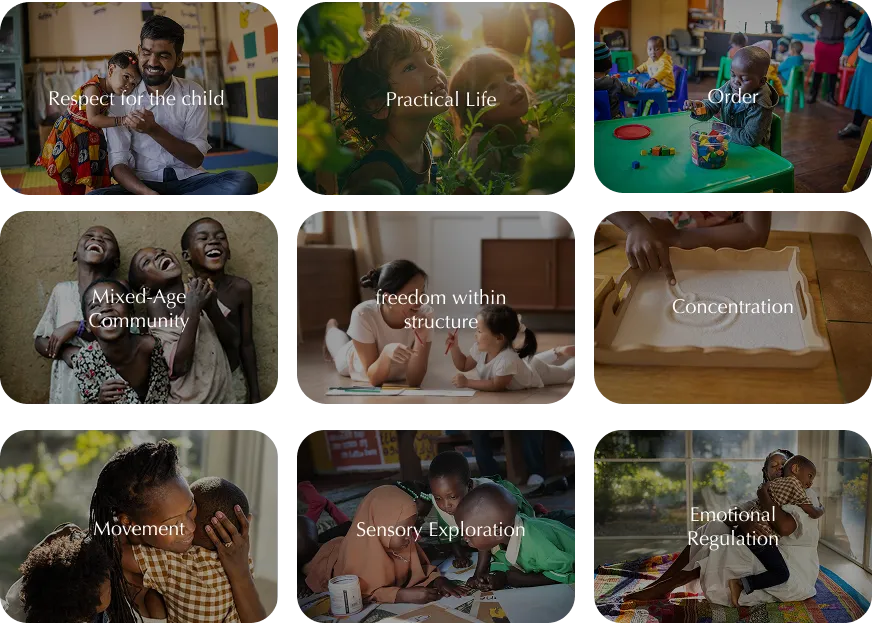
Respect for the child.
Freedom within structure.
Order and Movement
Purposeful activity
Emotional security and belonging.
Love and Care
Across cultures, research, and traditions, the highest-quality early childhood environments share the same foundations.
Not ideology.Not trends.But principles observed for more than a century — and now confirmed by neuroscience.
“But here is the problem: The best ECD approaches in the world… are reserved for the privileged few.”
THE REAL INJUSTICE

Excellence exists, but almost no child can access it

The world’s best early childhood approaches consistently deliver extraordinary outcomes.
But they remain rare, expensive, and inaccessible.

High-quality environments require trained adults, time, and guidance — conditions concentrated almost exclusively in wealthy communities.

Across Africa, South Asia, and Latin America, fewer than 1% of children experience early learning environments of this quality.

The children who would benefit most are the least likely to receive it.

This is not a failure of pedagogy.
It is a failure of delivery.
Humanity doesn’t need to reinvent early childhood. It needs a breakthrough in how excellence is delivered. That breakthrough is Indaba.
Project phase
Discovery audit
Cursor icon showing a hand pointer
Planning brief
Execution track
Performance review
Why it matters

The Global Consensus: 3 Cornerstones to Transform ECD

Universal Quality ECCE is possible, we can build education systems that will place millions of children today on the path of fulfilling their potential.

Experts and institutions worldwide agree: To unlock every child’s potential, the world must focus on three essential pillars.
01
Highest Quality Pedagogy and Experiences
→ Global standards & best practices
→ High-quality curricula & learning tools
→ Assurance of excellence for every child
02
A Well-Trained Workforce at Scale
→ Millions of teachers & caregivers trained
→ Scalable, cost-effective certification
→ Parents & communities actively engaged
03
A Supportive Ecosystem
→ Innovative funding & sustainability models
→ Technology-enabled monitoring & learning
→ Advocacy & global partnerships

“This is the foundation the world needs — but no global player has yet brought all three together.”

The world doesn’t need a new pedagogy.It needs a new way to deliver the best one.
→ Explore the work behind the vision