Evidence & Impact
Evidence Over Exaggeration.
What we can show today, what each piece of evidence does and does not show, and where it comes from. Hope deserves honesty.
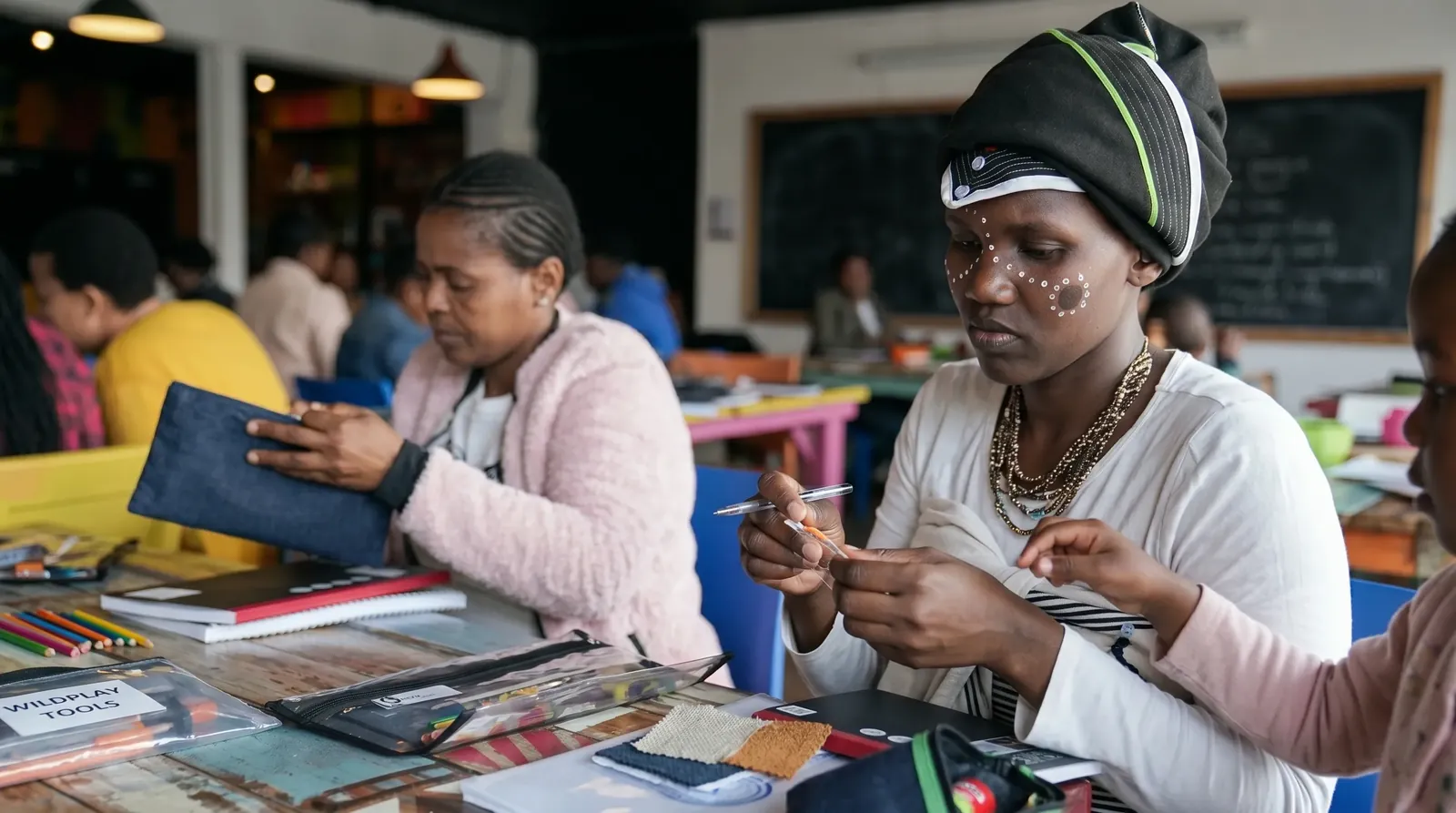
01One community, in detail
Learning from Kayamandi.
A case study told in the order it happened. Each indicator says how to read it and where it comes from.
Case study · Kayamandi, near Stellenbosch, South Africa
Local women, trained as teachers, in the community they serve.
Kayamandi: an open yard and the people crossing it.2021
The first CoRE programme in South Africa, after a pilot in India: 24 days of contact time in English and isiXhosa. Seventeen practitioners completed it with EsF certificates.
Read it asA proof of concept. A shift in practice was possible, but training alone was not enough: practitioners also needed direct, individual support.
SourceIndaba Prospectus 2024, as published by the Indaba Foundation.
2024
CoRE facilitators begin training to use the Early Learning Outcomes Measure, so that children’s development can be assessed independently.
Read it asPreparation for measurement, not a result.
SourceIndaba Prospectus 2024, as published by the Indaba Foundation.
35· 31 centres
teachers and principals from 31 early childhood centres began the 2025 group.
Read it asFacilitator visits describe practice changes; not a controlled evaluation.
SourceKayamandi 2025 Group 1 Report #1, summarised by the Indaba Institute.
81%of 48 children
assessed in 15 CoRE-affiliated programmes were on track for their age (ELOM 4&5, June 2026).
Read it asA single-site, once-off snapshot with no comparison group: it shows where these children stand, not how much CoRE added. For context only, 46 per cent of children in early learning programmes nationally were on track (Thrive by Five Index 2024).
SourceIndependent, accredited ELOM assessor (DataDrive2030), as summarised in Indaba’s ELOM evidence briefing, June 2026.
“What stood out to me was the transformation in the women. At the outset they were reluctant to speak… By the end of our journey together, the women now had opinions which they were not afraid to voice; were confident enough to ask questions and to trust their own intuition to follow the child.”
“You must look at a child as a seed, by preparing the soil, putting some water… the seed grows on its own. So, it works the same with the child.”
Next: CoRE work in Mkalama and Zanzibar, Tanzania. Figures are withheld until the field report is reviewed.
02What we can show
Four Pieces of Evidence. Each With Its Limits.
Filter by kind. Every item names its source, and what it cannot tell you.
Observed in practice
Field practice · Kayamandi, South Africa · 2025
CoRE in Kayamandi.
- What it shows
- A 2025 CoRE group began with 35 teachers and principals representing 31 early childhood centres. Facilitator visits describe practical changes, such as bringing materials within children’s reach and organising activities.
- What it does not show
- These are practice observations, not a controlled evaluation or evidence of long-term outcomes.
- Source
- Kayamandi 2025 Group 1 Report #1, as summarised by the Indaba Institute.
Independently assessed
Child assessment · Kayamandi · 2026
An independent ELOM snapshot.
- What it shows
- An accredited, independent assessor used the Early Learning Outcomes Measure (ELOM 4&5), a standardised direct assessment, with four- and five-year-olds in CoRE-affiliated early learning programmes in one community, in isiXhosa.
- What it does not show
- It is a single, once-off assessment of how children were doing at the time, with no comparison group. It does not show that the programme caused the results, and we do not present it as if it did.
- Source
- Indaba evidence briefing (June 2026) summarising an independent ELOM 4&5 assessment.
Under review
Field practice · Tanzania
CoRE in Mkalama and Zanzibar.
- What it shows
- CoRE work is identified in Mkalama and Zanzibar, Tanzania.
- What it does not show
- Figures are withheld until the field report is reviewed.
- Source
- Indaba Institute master brief; field report under review.
Prior track record
Educational media at scale.
- What it shows
- Before Indaba, members of the team built and ran large-scale educational media.
- What it does not show
- This is the team’s earlier experience, not Indaba’s own sales or reach.
- Source
- As reported by Sikana; prior team track record.
03How we label what we say
Observed, Assessed, Illustrative or Ambition.
On this site, a statement is labelled for what it is, so that an observation is never read as a result and an ambition never as an achievement.
- Observed in practice
- Seen in classrooms or training during facilitator and field visits, and described as an observation, not a measured outcome.
- Independently assessed
- Measured by someone outside Indaba, with the method and its limits named beside the result.
- Under review
- Work we can identify, with figures withheld until the report behind them has been reviewed.
- Prior track record
- The team’s experience before Indaba, never presented as Indaba’s own reach or sales.
- Illustrative
- A diagram or concept image that explains an idea. It is not a result, and concept images are captioned as such.
- Ambition
- A goal we are working towards, such as becoming a widely trusted reference for quality. It is not something we hold today.
04What we will not claim
Five Commitments.
- 01
No causation without design
We do not say a programme caused an outcome unless the design of the evidence can show it.
- 02
No borrowed credentials
We do not describe a seal, standard or accreditation as held until it has been formally conferred.
- 03
No forecasts as facts
Forecasts, scenarios and targets are labelled as such and kept apart from results.
- 04
Dated, sourced figures
Every figure carries its date and source, and overlapping estimates are never added together.
- 05
Dignity in every image
People are shown with dignity and agency, never as a spectacle of need.
05Go deeper
Where the Detail Lives.
The ELOM method and its limits are set out in full on the Indaba Foundation site. CoRE’s field practice is described on its pathway page.
ELOM method and limits (another Indaba site)CoRE TeachersOur Expertise
CoRE, designed by Educateurs sans Frontières (EsF), is delivered with the Indaba Institute.
Ask us
Questions About the Evidence?
If you want the detail behind any statement on this site, ask. We would rather show our working than overstate it.